



Security portocol
Rules and Fair play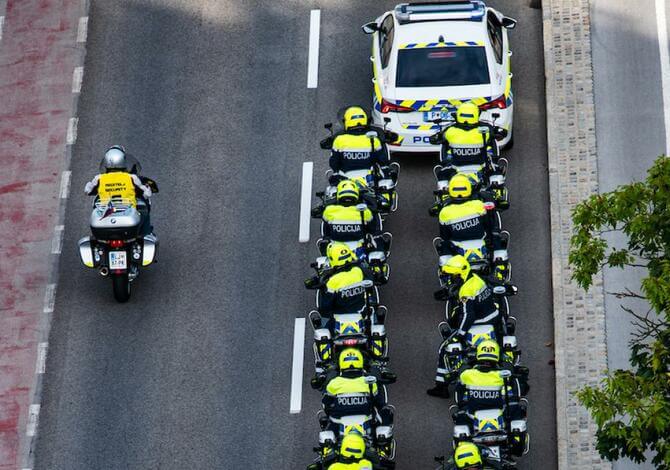
We ensure security together
Cycling events of L'Etape Slovenia by Tour de France take place on roads closed to public traffic and/or accompanied by safety vehicles. As a result, the roads and access points to the routes are occasionally fully closed for short periods (30–60 minutes). Safety is ensured by police officers in vehicles and on motorcycles, medical staff, technical support teams, and numerous marshals.
Safety is our top priority, so we encourage all participants to follow traffic regulations as well as the instructions of marshals, police officers, and stewards.
Sports etiquette and the principles of fair play
While fair play is often associated with sports its values are so universal that they are leveraged to all aspects of life, including education, business, culture, traffic, family relationships, and relationships with loved ones. Formal and informal rules aim to ensure equal opportunities for everyone to achieve their goals and encourage a fair intention – that our actions steam from the principle of honesty and fairness.
Ride & Race: Kilometer 0 - closed ride
To ensure the safety of all participants in Sunday's cycling test, a closed ride takes place up to kilometer 0, which is marked on the route. This means that overtaking the front escort vehicle is not allowed.
Ride & Race: Time Limit: 25 km/h
Due to the full road closures required for the Sunday long-distance event, a time limit applies. To enter the second loop/lap, participants must maintain an average speed of at least 25 km/h. If this speed is not achieved, the participant must cross the finish line upon returning to the start–finish area, where they will be classified with the result of the shorter course.
If a participant is caught by the last vehicle of the mobile road closure (the “broom wagon”) – a police vehicle with flashing red‑blue lights and a “end of closure” sign – they are then considered part of normal traffic and must ride in accordance with traffic regulations. You may continue cycling toward the finish, but please note: you are no longer riding on roads closed to public traffic, so extreme caution is required. Police officers, motorcyclists, and marshals will still be present along the route to help ensure safety.
Riding in a caravan demands total focus
Cycling in a group – a peloton – requires increased alertness and complete focus. A few recommendations:
- Riding in a group allows for significantly higher speeds, which requires better physical and mental preparedness, greater skill, full concentration, and constant awareness of the group’s dynamics.
- Risks: A pace that is too fast can lead to quicker exhaustion; a moment of inattention can cause a crash; when trying to “catch” the group, riders often forget to take in enough nutrition and hydration, which can lead to cramps, tired legs, and discomfort.
- Advantages: Riding in the slipstream is easier, as you expend less energy.
- Group dynamics:COLLEGIALITY Within the group, agree on rotating at the front and riding in the slipstream to make the best use of the group’s overall dynamics.
- Sudden movements endanger your safety and the safety of others, so avoid abrupt changes in speed and/or swerving.
- Discarding bottles is not allowed, except in specially designated zones.
Part 1: Cycling Academy with Matej Mohorič
Respectful. Sporty. Safe.
Because safety is a value we all share, we’re launching a new content series designed to empower recreational cyclists—beginners and seasoned riders alike—with the awareness and skills to ride safer, steadier and more confidently. From the start line to the finish, whether you’re commuting, training or taking on a challenge.
Dive into Part 1: Safe on the Road – for Yourself, Your Group and Your Spectators.
Part 2: Cycling Academy with Matej Mohorič
Respectful. Sporty. Safe.
In the second part, we focus on the importance of having a technically sound bicycle — something we are each responsible for. For a smoother and safer cycling season, we recommend a full professional inspection and service before the season begins and before any major or demanding cycling challenges you plan to undertake. We also advise simple at home checks before every ride,
>>> Part 2: Quick Technical Check Before Riding
Part 3: Cycling Academy with Matej Mohorič
Respectful. Sporty. Safe.
In the third part we focus on two areas that are among the most everyday aspects of recreational cycling, yet often decisive: riding in a small group and skill drills you can safely practice in a calm, controlled environment.
>>> Part 3: Small Group, Big Habits – and the Exercises That Make a Difference
Part 4: Cycling Academy with Matej Mohorič
Respectful. Sporty. Safe.
In the fourth article of the series, we touch on a topic we all know but often underestimate: physical preparation. At the Merkur zavarovalnica L’Etape Slovenia by Tour de France events, enjoyment is possible at various levels, but the difference between "I survived" and "I rode smartly" is made long before in the months when you are planning your participation.
>>> Part 4: The Secret to Good Form and a Calm Mind on Event Day
Part 5: Cycling Academy with Matej Mohorič
Respectful. Sporty. Safe.
In the fifth part of the Cycling Academy with Matej Mohorič, created as part of Merkur zavarovalnica L’Etape Slovenia by Tour de France, we return to the foundation that ultimately matters most: how we behave on the bike. This time, we summarise the key habits of safe and respectful riding in traffic, reminding cyclists as the more vulnerable road users not to look for shortcuts, not to force right of way, to respect red lights, pedestrian crossings, overtaking rules, and to use available cycling infrastructure.
>>> Part 5: Cycling Etiquette and Traffic Rules – Riding Safely When You’re the Fragile One in Traffic
Part 6: Cycling Academy with Matej Mohorič
Respectful. Sporty. Safe.
In Part 6 of the Cycling Academy with Matej Mohorič series, created as part of Merkur zavarovalnica L’Etape Slovenia by Tour de France, we focus on the moment when theory turns into practice—race day.
>>> Part 6: Between Reason and Adrenaline – The Art of Smart Racing
Part 7: Cycling Academy with Matej Mohorič
Respectful. Sporty. Safe.
In part 7 we focus on a very real feeling that most recreational cyclists know—but rarely admit out loud: uncertainty and fear on descents. At mass events like these, the pace increases, speeds are higher than during training rides, and you are surrounded by many other cyclists. Descents become faster, reactions must be smoother, and there are more decisions to make. The difference between a good and a bad day often lies precisely in how well you can stay calm and maintain control in these moments.